
Commercial cleaning services are the recurring, contracted cleaning of a business property — offices, medical suites, strata common areas, retail floors, warehouses and hospitality venues — carried out on a fixed schedule by an insured contractor instead of by your own staff. In Metro Vancouver, that normally means an after-hours crew, a written scope of work, and one predictable monthly invoice tied to a service agreement.
If you have never bought commercial cleaning in Vancouver before, the hardest part is not choosing a vendor. It is knowing what a competent one is supposed to deliver, so you can tell the difference between a real proposal and a low number on a page. Here is what businesses should expect, before signing and after.
What to expect at a glance
- A site walkthrough before any firm price is quoted
- A written scope of work listing tasks by area and by frequency
- Proof of liability insurance and WorkSafeBC coverage in good standing
- A named, consistent crew and a supervisor you can reach
- Documented quality inspections, usually monthly or quarterly
- Supplies, equipment and consumables clearly assigned to one party
- A 30-day cancellation clause in the service agreement
What are commercial cleaning services?
Commercial cleaning is scheduled maintenance cleaning of a workplace, priced as an ongoing service rather than a one-time job. It differs from residential cleaning in three ways that matter to a business: the work happens on a contract, it is performed outside your operating hours, and the contractor carries the insurance and payroll obligations for the people doing it.
Most Metro Vancouver providers organise the work by property type, because a dental suite, a strata lobby and a distribution warehouse have almost nothing in common operationally. At Vancouver Office Cleaners, that shows up as separate programs for commercial office cleaning, medical and dental office cleaning, strata building cleaning and full-building facility cleaning.
What should you expect before you sign?
Quick answer: a walkthrough, a written scope of work, a quote that explains how it was calculated, and documented proof of insurance and WorkSafeBC standing. A commercial cleaner who will price your building over the phone without seeing it is guessing, and you will pay for that guess later in reduced hours.
A walkthrough and a written scope of work
A proper walkthrough takes 20 to 45 minutes for a typical office floor. The estimator is measuring cleanable square footage (not leased square footage), counting washroom fixtures, identifying floor types, noting glass and elevator surfaces, and asking about headcount and traffic patterns. What comes back should be a task list organised by area and frequency — not a paragraph that says “general office cleaning.”
A quote that explains its own math
You should be able to see how many cleaner-hours per visit you are buying and at what effective rate. Provincial wage data helps you sanity-check it: WorkBC lists a median wage of $20.00 per hour for light duty cleaners in B.C. Once payroll burden, WorkSafeBC premiums, supervision, supplies, equipment and margin are added, a bid priced far below the market is usually a bid with hours quietly removed. Our Vancouver office cleaning cost guide breaks the arithmetic down.
Insurance, WorkSafeBC coverage and bonding
Expect a certificate of commercial general liability insurance, and expect the cleaner to produce a WorkSafeBC clearance letter on request. That letter confirms the contractor is registered and current on premiums — and if they are not, the business that hired them can be held liable for those premiums. You can read WorkSafeBC’s explanation of clearance letters before your next vendor conversation. Bonding is a separate protection; we cover the distinction in bonded vs. insured cleaners.
What should you expect after you sign?
Quick answer: a consistent crew who learn your building, a supervisor who inspects the work rather than relying on your complaints, clearly assigned supplies, and a communication channel that gets a response within one business day.
A consistent crew, not a rotating cast
Cleaning quality is mostly a function of familiarity. A cleaner on their fourth month in your office knows which meeting room fills up on Thursdays, which washroom dispenser jams, and that the boardroom glass shows every streak under the afternoon light. High crew turnover is the single most reliable predictor of a contract going bad, which is why you should ask about turnover before you ask about price.
Supervision and documented inspections
Expect a scheduled inspection with a written score or report, plus an escalation path when something is missed. Industry management frameworks such as ISSA’s Cleaning Industry Management Standard (CIMS) exist specifically because consistency comes from process, not effort. If quality control in your proposal means “call us if there is a problem,” you are the quality control system.
Supplies, equipment and consumables
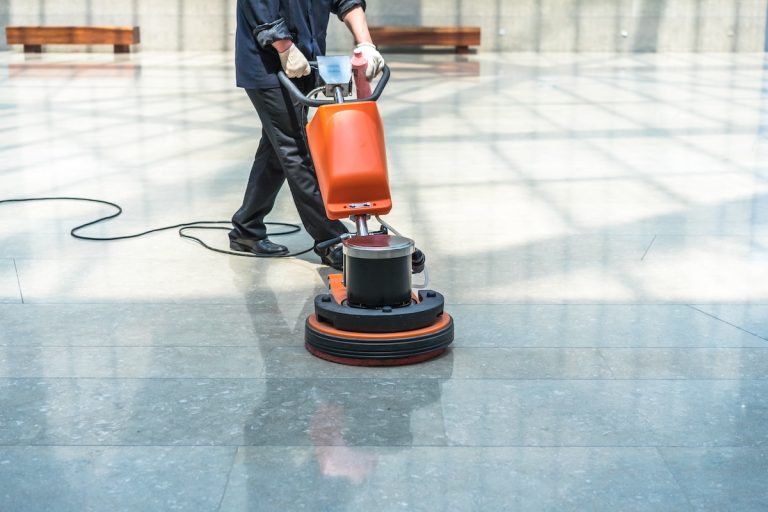
Cleaning chemicals, vacuums, floor machines and microfibre are almost always the contractor’s responsibility. Consumables — hand towel, tissue, soap, liners — go one of two ways: you buy and stock them, or the cleaner supplies them at cost plus a handling percentage. Both are fine. What is not fine is a contract that never says which one applies, because that gap turns into an empty dispenser at 9:05 on a Monday.
Communication that does not depend on chasing
You should have one named contact, a response commitment in writing, and a simple way to log a request. Good commercial cleaners also report upward: a note that a washroom faucet is leaking or that an exterior door is not latching is worth more to a facility manager than a spotless baseboard.
What a typical Vancouver service schedule looks like
| Frequency | Typical tasks |
|---|---|
| Every visit (nightly or set days) | Washroom clean and restock, kitchen and lunchroom, waste and recycling, high-touch disinfection, vacuum traffic lanes, spot-clean glass, entrance mats |
| Weekly | Full vacuum including under desks, hard-floor damp mop, dusting of horizontal surfaces, interior partition glass |
| Monthly | High dusting, vents and diffusers, baseboards, door frames, elevator tracks, kick plates |
| Quarterly to semi-annual | Carpet extraction, hard-floor scrub and refinish, upholstery, interior windows |
| Annual | Strip and seal or deep restoration, exterior window service, full-building detail |
The heavier periodic work — floor care and carpet cleaning — can be bundled into the monthly contract price or quoted separately. Bundling smooths your budget; separate quoting gives you the option to defer. Ask which model the proposal uses.
What is usually not included
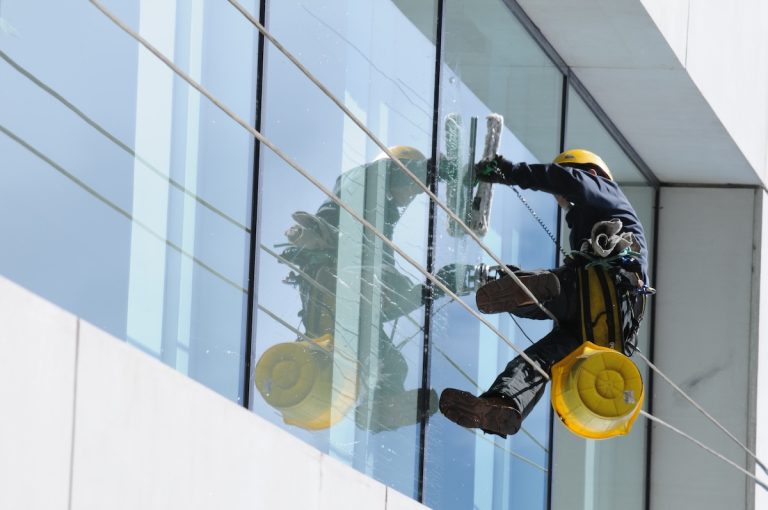
- Exterior window washing above ground level (specialised, separately insured)
- Post-construction and renovation cleanup
- Biohazard, hoarding or crime-scene remediation
- Snow and ice clearing, landscaping, pressure washing (sometimes available as an add-on)
- Moving furniture, IT equipment or personal items
- Dishwashing personal dishes left in the sink — a surprisingly common source of friction
Metro Vancouver conditions that change your scope
Local conditions are not a marketing line here; they change the task list. From October through March, sustained rain means entrance matting, wet-floor management and far more frequent hard-floor attention near every door. Glass-heavy towers downtown and in Burnaby need interior glass on a tighter cycle than a suburban business park. Buildings pursuing LEED certification through the Canada Green Building Council often require certified low-VOC products and documented waste diversion. And if your site sits outside the core, look for a provider with real crew coverage there — ours spans Burnaby, Richmond, Surrey and Coquitlam.
Six red flags in a commercial cleaning proposal
- A firm price with no site visit
- A scope of work shorter than one page
- No certificate of insurance or WorkSafeBC clearance offered
- A bid materially below every other bid you received
- No named supervisor and no inspection schedule
- An auto-renewing term longer than 12 months with no 30-day out
Frequently asked questions
How soon can a commercial cleaning service start?
For a standard office, one to two weeks from signed agreement is normal. That window covers crew scheduling, key or fob issuance, alarm codes and a supervised first clean. Buildings needing security clearance or after-hours access approval from property management can take longer.
Do commercial cleaners work during business hours?
Most Vancouver offices are cleaned after hours, typically between 6:00 p.m. and midnight. Day porter service during business hours is a separate line item and is common in larger buildings, lobbies and high-traffic retail.
Is a long-term contract required?
No. A 12-month term with a 30-day cancellation clause is the common structure in Metro Vancouver. Terms longer than 12 months without an exit clause are worth negotiating before you sign.
Who supplies the cleaning products?
The contractor supplies cleaning chemicals and equipment. Washroom and kitchen consumables are negotiable and should be stated explicitly in the agreement.
Get a scope and a price for your building
Vancouver Office Cleaners provides bonded and insured commercial cleaning across Metro Vancouver, with a written scope of work, a named supervisor and documented inspections on every contract. Book a walkthrough and we will price your actual building rather than an average of buildings like it.